
The combined market valuation of the top-ten most valued firms jumped by a whopping Rs 3,84,004.73 crore in the holiday-shortened last week, in-tandem with a smart rally in equities, with HDFC Bank and Bharti Airtel emerging as the biggest gainers. Last week, the BSE benchmark Sensex jumped 3,395.94 points or 4.51 per cent, and the NSE Nifty surged 1,023.1 points or 4.48 per cent.
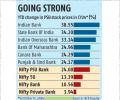
Stock Market News today, PSU banks: The year 2024 was a roller-coaster ride for Indian stock markets, marked by volatility driven by the Lok Sabha elections, Union Budget 2024, a slowdown in corporate earnings, and sticky inflation. Geopolitical tensions - particularly between Israel and Iran in West Asia - along with various stimulus announcements by China and yen carry trade rocked the equity markets throughout the year.

Many high-profile IPOs in India since 2021 have destroyed investor wealth due to overvaluation, weak business models, and post-listing disinterest, turning 1 lakh investments into as little as 3,500.

West Bengal is home to 43,000 Durga Pujas, and the business around it is a major economic driver.

Sun Pharma, Tata Steel, State Bank of India, Axis Bank, Tata Motors, Larsen & Toubro and ICICI Bank were also among the Sensex gainers. HCL Tech, UltraTech Cement, Nestle and Hindustan Unilever were among the laggards.

'Just the amount of work which is there just to become more and more successful in banking. For this to happen you need to have leaders who understand technology.'

Wholesale price inflation dropped to 0.85 per cent in April as prices of food articles, manufactured products, and fuel eased, government data showed on Wednesday. WPI-based inflation was 2.05 per cent in March. It was 1.19 per cent in April last year.

Some major contracts coming up for renewal include TCS' deals with Star Alliance, a consortium of airlines based in Germany, and Nielsen; Infosys' deals with GE Appliances and Daimler; HCLTech's with UK-based life insurer Chesnara; Wipro's with German electric utility company E.ON and Petrobras of Brazil; and Tech Mahindra's with Circle Health.

Banking credit in the economy grew by 11.1 per cent year-on-year (Y-o-Y) in the fortnight ended March 7, while deposits grew at 10.2 per cent during the same period, which is a gap of around 90 basis points (bps), according to the latest data from the Reserve Bank of India (RBI).

Wholesale price inflation eased to 2.05 per cent in March, as against 2.38 per cent in February, government data showed on Tuesday. The wholesale price index (WPI) based inflation, however, rose year-on-year.

From the Sensex pack, Bharti Airtel, Titan, Tata Consultancy Services, Hindustan Unilever, Infosys, Nestle, Reliance Industries, Mahindra & Mahindra, HDFC Bank and Tata Motors were the biggest gainers. However, IndusInd Bank, Bajaj Finance and UltraTech Cement were the laggards.

From the Sensex pack, IndusInd Bank, Infosys, Bajaj Finserv, Mahindra & Mahindra, Zomato, Hindustan Unilever, Power Grid, Axis Bank, UltraTech Cement, Adani Ports, and Tata Consultancy Services were among the laggards. On the other hand, Sun Pharmaceuticals, ICICI Bank, Bharti Airtel, HCL Technologies, Maruti Suzuki India, Larsen & Toubro, Reliance Industries, Kotak Mahindra Bank and Titan were the gainers.

Brokerages expect a further slowdown in Indian firms' revenue and earnings growth in Q4FY25, following low single-digit growth in the preceding three quarters, as factors like weak consumer demand and credit growth linger on.

From the Sensex pack, Zomato jumped over 7 per cent. ICICI Bank, Mahindra & Mahindra, Tata Motors, Larsen & Toubro, Asian Paints, Titan, Kotak Mahindra Bank and State Bank of India were among the gainers. However, Bajaj Finserv, Bharti Airtel, Tech Mahindra and Reliance Industries were the laggards.

In response to the panic triggered by Trump's trade policies, the RBI net sold approximately $43 billion in the second half of FY25 to curb volatility, as the rupee plunged to a low of 87.95 per dollar in February this year.

Retail inflation eased to a nearly six-year low of 3.16 per cent in April mainly due to subdued prices of vegetables, fruits, pulses, and other protein-rich items, creating enough room for the Reserve Bank to go for another round of rate cut in the June monetary policy review. The Consumer Price Index (CPI) based inflation was 3.34 per cent in March and 4.83 per cent in April 2024. It was 3.15 per cent in July 2019.
ICICI Bank share price hits record high, ICICI Bank m-cap tops $100 billion: Shares of ICICI Bank have been on a steady uptrend, rising 30 per cent over the past one year; not far behind Axis Bank stock that surged over 34 per cent during the period. The BSE Sensex, meanwhile, is up 25 per cent, and the BSE BANKEX 22 per cent in the last one year, ACE Equity data shows. On Wednesday, June 26, ICICI Bank shares hit a fresh record high for the third consecutive day, rising 2 per cent on the BSE in the intraday trade.

All sectoral indices ended lower. BSE Telecommunication tanked 2.18 per cent, metal (1.77 per cent), auto (1.70 per cent), energy (1.64 per cent), oil & gas (1.59 per cent), commodities (1.39 per cent) and financial services (1.37 per cent) were the major laggards.
The RBI is likely to reduce the key interest rate by 25 basis points this week after keeping it on hold for two years, complementing the Union Budget initiatives to push consumption-led demand, though the sliding rupee continues to be a concern. As the retail inflation has remained within the Reserve Bank's comfort zone (less than 6 per cent) for most of the year, the central bank can take rate action to boost growth hit by sluggish consumption, opined experts.

From the Sensex basket, Tech Mahindra, Tata Steel, JSW Steel, HCL Technologies, Tata Consultancy Services, Larsen & Toubro and Kotak Mahindra Bank were the biggest laggards. Mahindra & Mahindra, Power Grid, Bajaj Finance, IndusInd Bank and Maruti were the major gainers.

Shares of state-owned bank stocks were under pressure on Monday due to muted deposit and credit growth numbers reported by these lenders in the October-December quarter (Q3) of 2024-25 (FY25). The Nifty PSU Bank index was down 4 per cent, with Union Bank of India emerging as the biggest loser as its shares fell 7.5 per cent to close at Rs 114.7, followed by a 5.7 per cent drop in shares of Bank of Baroda (BoB) to Rs 228 and a 4.7 per cent slide in shares of Bank of India to Rs 99.8 on the National Stock Exchange.

'A credit line on UPI is going to make banks think about credit fundamentally as they digitise the credit process entirely.'

Falling for the fifth day in a row on Monday, equity benchmark BSE Sensex tumbled over 1 per cent to drop below the crucial 75,000 level, tracking a US market trend and unabated foreign fund outflows amid concerns over US tariffs. The 30-share BSE benchmark tanked 856.65 points or 1.14 per cent to settle at 74,454.41. During the day, it plummeted 923.62 points or 1.22 per cent to 74,387.44.

Among the Sensex firms, ITC, Kotak Mahindra Bank, ICICI Bank, Nestle, Axis Bank, IndusInd Bank, UltraTech Cement, Bajaj Finance, Maruti and HDFC Bank were the major laggards.

Goldman Sachs expects gold to reach $3,150 per ounce in the international market by December 2025, up around 19.1 per cent from its current level of $2,645, according to a recent report in Business Standard. Domestically, gold is trading at Rs 76,018 per 10 grams after delivering a remarkable 21.9 per cent return in the past year.

Credit card spending reached Rs 2 trillion in October, a 14.5 per cent rise from September, largely driven by festival season purchases. However, the volume of outstanding credit cards increased only marginally during the same period. The spike in spending comes at a time when nearly all major credit card issuers are calibrating their growth in the segment due to visible signs of stress.

Credit card spending in September recorded strong growth of 25 per cent year-on-year (Y-o-Y), marking the highest increase in six months. Even as many banks saw higher slippages during the July-September quarter of 2024-25, spending growth exceeded 20 per cent for the first time since February. According to the latest data released by the Reserve Bank of India (RBI), September spending reached Rs 1.76 trillion, compared to Rs 1.42 trillion in the same period a year ago. In August 2024, credit card spending was Rs 1.68 trillion.

Gold prices slumped for the second straight session by Rs 1,150 to Rs 78,350 per 10 grams in the national capital on Monday on frantic selling by stockists and retailers, the All India Sarafa Association said. The precious metal of 99.9 per cent purity closed at Rs 79,500 per 10 grams on Friday.

After Chennai, it is Coimbatore, Madurai, and Tiruchirappalli, that are emerging as manufacturing hubs. Coimbatore is India's top Tier-II city in terms of the number of GCCs, according to a report by Cushman & Wakefield.

Among the 30-share Sensex blue-chip pack, Bharti Airtel, ITC, Kotak Mahindra Bank, Hindustan Unilever, Titan, UltraTech Cement, HCL Technologies, and Power Grid, were the biggest gainers. Tata Steel, IndusInd Bank, JSW Steel and Bajaj Finserv were the laggards.

Banks, the biggest component of the Indian equity market, are now trading at a big discount to the benchmark indicesThe BSE Bankex index, which tracks the share price of the 10 top listed banks, is trading at a trailing price to earnings (P/E) multiple of 15.3X, nearly a 40 per cent discount to the BSE Sensex current P/E of 24.37X. This is the biggest valuation gap between the two indices in at least 10 years. Similarly, the BSE Bankex price to book ratio (P/B) of 2.22X is 40 per cent lower than the current Sensex P/B ratio of 3.61X.

Investors' sentiments will be guided by a host of domestic and global macroeconomic data announcements this week, along with the trading activity of foreign investors and trends in world stocks, analysts said. Besides, the rupee-dollar trend and movement of global oil benchmark Brent crude will also be crucial in dictating terms in the market, experts added.

In India, it is not easy to fight it out with the large banks which are nimble-footed and technology-savvy and are continuously innovating on the retail turf with newer products for customer acquisition.

Retail inflation declined to 6.83 per cent in August after touching a 15-month high of 7.44 per cent in July, mainly due to softening prices of vegetables, but still remains above the Reserve Bank's comfort zone. The overall inflation in the food basket stood at 9.94 per cent in August as against 11.51 per cent in July, according to data released by the National Statistical Office (NSO) on Tuesday. Retail inflation based on the Consumer Price Index (CPI) was at 7 per cent in August 2022.

Investors should view any bounce-back in bank stocks as an opportunity to exit the pack, analysts suggested, as the worst may not be over yet. The recent quarterly results of HDFC Bank and Axis Bank disappointed the Street, triggering a marketwide selloff by foreign institutional investors, especially in banking counters. While HDFC Bank, which was the anchor for the market correction during the past week, ended 2 per cent higher amid short covering on Wednesday, Axis Bank's shares settled 3 per cent lower.
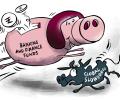
Even as banks and finance companies are reporting record-high earnings, their weighting in the benchmark National Stock Exchange Nifty50 Index has seen a downward trajectory. Investors expect a stronger performance from other sectors in the new year. Currently, banking, financial services and insurance (BFSI) companies collectively hold a weighting of 34.5 per cent, down from 36.7 per cent at the end of December 2022 and a record high of 40.6 per cent at the end of December 2019. This represents the sector's lowest weighting in the index since December 2021 when it stood at 33.7 per cent.

Retail inflation rose to three-month high of 4.81 per cent in June, mainly on account of hardening prices of food, according to the government data. Inflation based on the Consumer Price Index (CPI) stood at 4.31 per per (revised upward from 4.25 per cent) in May and 7 per cent in June 2022. The inflation, however, remains within the RBI's comfort level of below 6 per cent.

Benchmark Sensex closed above the 85,000 level for the first time while Nifty scaled the 26,000 peak at close on Wednesday as fag-end buying in banking and power shares helped stock markets recoup early losses. After a see-saw trade during the day, the 30-share BSE Sensex rose by 255.83 points or 0.30 per cent to settle at an all-time high of 85,169.87. During the day, it surged 333.38 points or 0.39 per cent to hit a record intra-day peak of 85,247.42.

The stocks are largely from sectors such as chemicals, finance and cement, which struggled earlier but the worse seems to be behind them.

From the 30-share Sensex blue-chip pack, Titan, Adani Ports, UltraTech Cement, Tata Consultancy Services, NTPC, Bharti Airtel, Tech Mahindra, Infosys, Hindustan Unilever and JSW Steel were the biggest laggards.
 © 2026 Rediff.com - Advertise with us - Disclaimer - Privacy Policy - Sitemap - Feedback - About us - Terms of use - Grievances